

Yes, Medicare covers home health care, but only a specific kind: part-time skilled care at home that a doctor orders, for someone who is homebound. If you qualify, Medicare.gov says covered services come at no cost to you, and there is no cap on the number of visits. Round-the-clock care and help with bathing or meals on their own are not part of the benefit. Knowing where that line falls lets you plan the rest of your family's care before a crisis forces the question. Our skilled care team of nurses and therapists provides skilled home health services, and our care coordinators help families with scheduling and communication along the way.
TL;DR
- Medicare covers part-time or intermittent skilled nursing, physical, occupational and speech therapy, medical social services, and home health aide help when you also receive skilled care.
- To qualify you must be homebound, need skilled care, be under a doctor's or other allowed practitioner's plan of care, and use a Medicare-certified home health agency.
- Covered home health services cost $0. Durable medical equipment costs 20% of the Medicare-approved amount after the Part B deductible.
- Medicare does not pay for 24-hour care, home-delivered meals, or personal care as your only need.
- Hospice is a separate Medicare benefit with its own rules.
Table of Contents
- What the Medicare home health benefit actually is
- Who qualifies for Medicare home health coverage
- What Medicare covers, and what it does not
- What it costs
- How to start home health care, step by step
- Medicare Advantage and Original Medicare
- Mental health at home
- Home health versus hospice
- Putting Medicare and private care together
- Talk with Signal Health Group
- FAQ
- Sources
What the Medicare home health benefit actually is
The home health benefit pays for medical care delivered where you live. It is meant for recovery or management of an illness or injury: a nurse changing a surgical dressing, a physical therapist rebuilding strength after a hip replacement, a speech-language pathologist working with someone after a stroke.
It is not a long-term care benefit. Families often assume that Medicare will pay for someone to help Mom every day. It generally will not, and the difference shapes everything else in this article.
The benefit is paid through Part A, Part B, or both. According to CMS's Brief Summaries of Medicare & Medicaid, Part A covers the first 100 visits that follow a 3-day hospital or skilled nursing facility stay. Part B covers home health services that are not tied to a hospital or skilled nursing facility stay. In practice you do not need to sort out which part is paying. The agency bills Medicare, and the rules for what is covered are the same.
Who qualifies for Medicare home health coverage
There are four conditions, set out in 42 CFR 409.42, the federal regulation that defines who can receive the benefit.
- You are confined to the home (homebound).
- You are under the care of a physician or other allowed practitioner who sets up a plan of care.
- You need at least one qualifying skilled service: intermittent skilled nursing, physical therapy, speech-language pathology, or, in certain cases, occupational therapy.
- A participating home health agency provides the services.
What homebound means
Homebound does not mean bedridden. Medicare.gov describes it this way: leaving home is not recommended because of your condition, or it takes help from a cane, wheelchair, special transportation, or another person. You are also normally unable to leave, and doing so takes considerable effort.
You can still leave for medical treatment, and for short, infrequent outings such as religious services. Going to adult day care does not disqualify you.
The CMS compliance guidance on home health splits this into two tests that must both be met. First, you need a device, special transportation, or another person's help to leave home, or leaving is medically inadvisable. Second, you normally cannot leave, and doing so is a considerable and taxing effort.
Example: A 78-year-old woman is recovering from a fall and uses a walker. Getting down the front steps takes a helper and leaves her exhausted. She still attends church once a month with her daughter's help. She can meet both homebound tests, because the outings are short and infrequent.
What counts as skilled care
A service is not skilled just because a nurse performs it. Under 42 CFR 409.42, if non-licensed staff could safely and effectively do the task without a nurse supervising, it is not a skilled service. Wound care, injections, monitoring an unstable condition, and therapy to restore function are typical skilled needs. Teaching you or a family caregiver to manage a condition can also count, until it is clear that the person could not or would not be trained.
"Part-time or intermittent" has a meaning too. The Medicare Benefit Policy Manual defines intermittent skilled nursing as care needed on fewer than 7 days each week, or less than 8 hours each day, for periods of 21 days or less. Longer periods can be allowed in exceptional cases where the need is finite and predictable.
What Medicare covers, and what it does not
Per Medicare.gov, covered home health services include:
- Skilled nursing care on a part-time or intermittent basis
- Physical therapy, occupational therapy and speech-language pathology
- Medical social services
- Home health aide care for personal needs, but only while you are also receiving skilled care
- Injectable osteoporosis drugs for eligible women
- Durable medical equipment such as walkers or hospital beds
- Medical supplies
- Palliative comfort care
Medicare does not pay for 24-hour care at home, home-delivered meals, homemaker services unrelated to your care plan, or custodial care when it is the only care you need. CMS's summary adds that full-time nursing care, food, blood and drugs are not provided as home health services.
How many hours a week
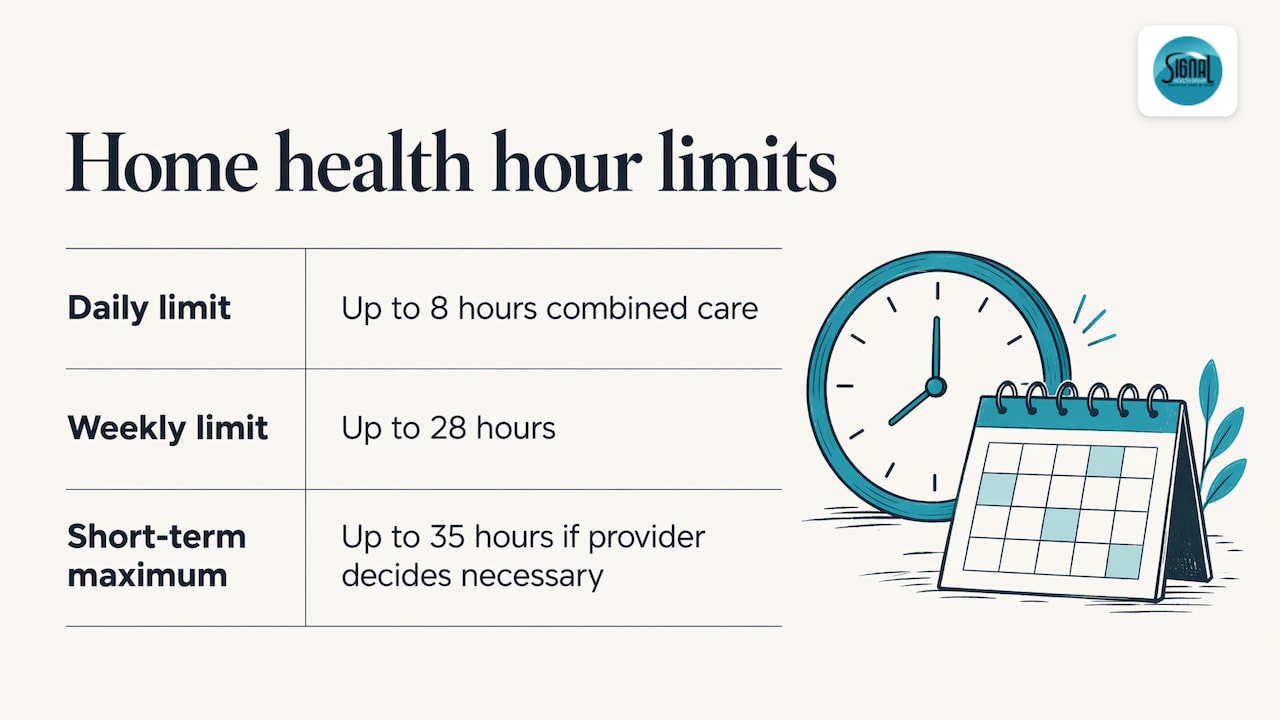
If you qualify, Medicare allows unlimited visits. The limit is on intensity: Medicare.gov says part-time or intermittent generally means up to 8 hours a day of combined skilled nursing and aide care, and a maximum of 28 hours a week. It can reach 35 hours a week for a short time if the provider decides it is necessary.
Where the gap shows up
A typical case: after a hospital stay, a father gets nurse visits for a wound and therapy sessions three times a week. That is covered. But he also needs help dressing, bathing and cooking every day, and the family wants someone there for long stretches. Aide visits can be covered alongside the skilled care. Daily hours of personal care and companionship beyond that are a separate, privately arranged need.
That is where many families end up combining two kinds of care. Our personal care services cover in-home personal care and companionship, and our wellness programs cover fitness, nutrition, meals and mental health. Our care coordinators support scheduling and communication so the skilled visits and the everyday help fit together.
What it costs
The cost picture is simple. Medicare's Home Health Benefit publication (August 2025) says you pay $0 for Medicare-approved home health services. For durable medical equipment you pay 20% of the Medicare-approved amount after the Part B deductible.
For calendar year 2026, CMS lists the Part B deductible at $283 and the standard Part B premium at $202.90 a month. Those figures are reset each January, so check the current year's amounts on Medicare.gov. Home health agency services themselves carry no deductible and no coinsurance, apart from that 20% for equipment.
What Medicare does not pay is what you owe in full if you choose to add it. The next section covers how agencies tell you before that happens.
How to start home health care, step by step
1. See your doctor or practitioner in person
A doctor or other health care provider, such as a nurse practitioner, must see you, confirm you need home health care, and order it, per Medicare.gov. Nurse practitioners, clinical nurse specialists and physician assistants are allowed practitioners who can certify eligibility, establish and review the plan of care, and supervise services.
The face-to-face encounter must happen no more than 90 days before the start of care, or within 30 days after, according to 42 CFR 424.22. It can be done by telehealth when the rules for telehealth are met. The certification should rest on real clinical detail: diagnosis, clinical course, prognosis and functional limits. Stock phrases alone are not enough, according to the Medicare Benefit Policy Manual.
Where it goes wrong: a visit note that never mentions how hard it is for you to leave home. Tell your practitioner plainly what leaving the house involves, so the record reflects it.
2. Choose a Medicare-certified agency
Medicare requires a Medicare-certified home health agency to provide the care. Your provider should give you a list of agencies in your area and tell you about any financial interest they have in one, per Medicare.gov. You choose the agency.
This is the step where coordination matters most. Skilled visits, aide help and family schedules all have to line up, and our care coordinators support that scheduling and communication. You can see our skilled care services for the nursing and therapy side.
3. Get the plan of care in writing
The plan of care lists the services, how often they happen, and the goals. Your practitioner reviews it periodically. Ask what each visit is meant to achieve, and who to call if a visit is missed.
4. Read every notice
Agencies must give you written notices at key points, per Medicare.gov's Your Protections page:
- An Advance Beneficiary Notice (ABN) before items or services Medicare may not pay for, such as personal care only, or when you are not homebound or lack an intermittent skilled need.
- A Home Health Change of Care Notice (HHCCN) when services are reduced or stopped because of a business decision or a change in orders.
- A Notice of Medicare Non-Coverage (NOMNC), given at least 2 days before all covered services end.
The NOMNC comes with appeal rights. If you disagree that services should end, follow the instructions on the notice right away.
Medicare Advantage and Original Medicare
The rules above describe Original Medicare. If you are in a Medicare Advantage plan, the plan must cover home health, but your plan may have its own network and approval steps. Call the number on your plan card before starting care so you know which agencies it uses.
Mental health at home
If the person you are caring for needs mental health support, the 2025 Medicare & You handbook says Medicare covers expanded mental health care, including services from marriage and family therapists and mental health counselors, and certain mental and behavioral health telehealth from home. That sits within Part B outpatient coverage, not the home health benefit. Our wellness programs include mental health support as part of the home-based care we offer.
Home health versus hospice
Hospice is a different benefit. Per the 2025 Medicare & You handbook, it is for people certified as terminally ill with a life expectancy of 6 months or less. It covers pain relief, symptom management, drugs, equipment, aide and homemaker services, and grief counseling. The handbook lists up to a $5 copay per outpatient prescription and 5% coinsurance for inpatient respite care.
Home health aims at recovery or stabilization. Hospice focuses on comfort and the whole person. If your family is facing that decision, our hospice care team provides medical and emotional support at home. Veterans and their families can also see our veterans page.
Putting Medicare and private care together
Most families need more than one layer of care. Here is a simple way to map it:
| Need | Medicare home health | What to arrange |
|---|---|---|
| Nurse visits for wound care or injections | Covered when skilled and ordered | Plan of care from your practitioner |
| Physical, occupational or speech therapy | Covered when ordered | Plan of care from your practitioner |
| Aide help with bathing while receiving skilled care | Covered, part-time | Included in the plan of care |
| Daily personal care and companionship | Not covered on its own | Private arrangement |
| 24-hour care | Not covered | Private arrangement |
| Meals and nutrition support | Not covered | Private arrangement |
We provide care across all of these needs: skilled home health, personal care, wellness and hospice, along with private-duty sitters for hospital stays. Because care is coordinated across them, one conversation can cover the whole picture. Our care coordinators support scheduling and communication, and our approach keeps families informed and gives them choices about their care.
Talk with Signal Health Group
If you are trying to work out which of your relative's needs Medicare can pay for and which it cannot, start with the plan. We offer skilled care from nurses and therapists, personal care, wellness programs and hospice, with services designed to help people keep their independence and dignity at home.

See our full list of services to find the right fit, or visit our preferred providers page to learn more about working with us.
FAQ
Does Medicare cover home health care?
Yes, when you are homebound, need part-time or intermittent skilled care, and have a plan of care from a doctor or allowed practitioner. A Medicare-certified agency must provide it. Covered services cost $0, except 20% of the approved amount for durable medical equipment.
Is home health covered under Part A or Part B?
Both can apply. Part A covers the first 100 visits after a 3-day hospital or skilled nursing facility stay, and Part B covers home health that is not tied to such a stay, per CMS. The agency handles billing, so the care itself is the same.
Does Medicare pay for a home health aide?
Yes, part-time, but only while you are also getting skilled care such as nursing or therapy. If the aide help would be your only need, it is considered custodial care and Medicare does not cover it, per Medicare.gov.
How long can I get home health care?
There is no limit on the number of visits as long as you continue to qualify. Your practitioner periodically reviews the plan of care, and you receive a written notice at least 2 days before covered services end.
Does Medicare cover 24-hour care at home?
No. Medicare does not pay for 24-hour care, home-delivered meals, or homemaker services that are unrelated to your plan of care. Families usually arrange those separately alongside covered skilled visits.
Sources
- Home Health Services Coverage, Medicare.gov
- Brief Summaries of Medicare & Medicaid, CMS, November 19, 2025
- 42 CFR 409.42, Beneficiary qualifications, eCFR
- Home Health Services, CMS Medicare Learning Network
- Medicare Benefit Policy Manual, Chapter 7, CMS
- 42 CFR 424.22, Requirements for home health services
- Home Health Manual Update to Incorporate Allowed Practitioners, CMS, March 1, 2020
- Your Protections, Medicare.gov
- Medicare's Home Health Benefit, August 2025
- CMS transmittal R13504GI, effective January 1, 2026
- Medicare & You 2025 handbook