

Companion care at home is non-medical help that keeps an older adult company and takes small daily burdens off their plate: conversation, supervision, light housekeeping, meals, errands. It fits a relative who is mostly independent but lonely or needs someone nearby. When bathing, dressing, toileting or medical tasks enter the picture, the need has moved beyond companionship. Signal Health Group provides in-home personal care and companionship alongside skilled home health, wellness programs and hospice, so a family can start with companionship and add support under one coordinated plan as needs change.
TL;DR
- Companion care is non-medical: social contact, supervision, recreation, light housekeeping, meal preparation and errands. It does not include hands-on personal care or nursing.
- Private-duty help averages $25 to $30 per hour, often with a three-to-four-hour weekly minimum, and Medicare does not typically pay for it.
- If your relative needs help with bathing, dressing, toileting or moving around, a trained aide is the right level, not a companion alone.
- Choose a provider that can move your relative to personal care, skilled care or hospice without starting over.
Table of Contents
- What companion care at home actually is
- Who benefits most
- What a companion does, and where the role stops
- Companion care, personal care, skilled care and hospice
- How to tell whether companion care is enough
- What companion care costs, and who pays
- How to choose a companion care provider
- Starting companion care: a simple plan
- Companion care with Signal Health Group
- When needs go beyond home companionship
- FAQ
- Sources
What companion care at home actually is
A companion is a person who comes to the home on a regular schedule to be with an older adult. The point is presence and routine: someone to talk with over lunch, play cards, take a walk, notice if something seems off, and keep the house running.
The National Institute on Aging describes friendly visitor and senior companion services as regular visits of under two hours that offer support, assistance and companionship, especially for people who live alone and need someone to check on them. Volunteer programs of this kind are free. Home health agencies offer the same type of service for a fee, with the advantage of set schedules, a defined service plan and a team behind the visit.
The Alzheimer's Association groups companion services as help with supervision, recreational activities or visiting, and separates them from personal care and from skilled care. That three-level split is the most useful way to think about the whole topic.
Who benefits most
Companion care tends to suit a relative who:
- lives alone and spends most days without conversation
- can still dress, bathe and use the toilet without help
- has stopped driving and needs rides to appointments, the pharmacy or the grocery store
- is safe alone for short periods but would benefit from someone checking in
- has a family caregiver who needs regular, predictable time off
Families often arrive here after a hospital stay, a spouse's death, or the first signs of memory change. In each case the goal is the same: keep your relative in a familiar home, with their routines intact, without moving to a facility.
What a companion does, and where the role stops
Typical companion tasks
- Conversation, games, hobbies, reading aloud, looking through photos
- Accompanying walks and light activity
- Meal planning and preparation, and eating together
- Light housekeeping and laundry
- Grocery shopping and errands
- Reminders about appointments and a watchful eye on safety
- Transportation to appointments or social events
The UHF Next Step in Care guide notes that homemakers handle light housekeeping, laundry, grocery shopping and food preparation but do not generally provide personal care.
What falls outside companion care
The federal long-term care ombudsman resource at LTCFEDS describes a companion as someone who can provide homemaker services but is not trained in body mechanics and cannot provide hands-on care. A certified nursing assistant (CNA), by contrast, is a trained, licensed professional who can help with bathing, dressing, feeding and toileting.
This boundary exists for safety. Lifting or transferring someone, or bathing a person with dementia, takes training. The UHF guide makes the point that these tasks are far from unskilled, and can be very difficult.
One practical detail: a home health aide is usually there to serve the patient only. The same guide says an aide is not supposed to serve a spouse or other household members, although with private payment you may assign tasks that include them. If your relative lives with a spouse who also needs company, say so when you set up the plan.
Companion care, personal care, skilled care and hospice
Families searching for "companionship" are often really asking which level of help they need. This table shows how the levels differ.
| Level | What it is | Who provides it | Examples |
|---|---|---|---|
| Companion care | Social and household support, supervision | Companion or homemaker | Visits, meals, errands, light housekeeping |
| Personal care | Hands-on help with activities of daily living | Trained aide or CNA | Bathing, dressing, grooming, toileting, eating, moving from bed to chair |
| Skilled home health | Medical care ordered by a physician | Nurses, physical and other therapists | Wound care, injections, medication management, physical therapy |
| Hospice | Comfort-focused medical and emotional support near the end of life | Hospice care team | Symptom management, emotional and spiritual support for the patient and family |
The NIA defines personal care as everyday activities such as bathing, dressing, grooming, using the toilet, eating and moving around. Skilled care, according to the Alzheimer's Association, is given by a licensed professional such as a nurse or physical therapist and is usually coordinated by a home health agency once a physician orders it.
These levels are not separate worlds. A relative who starts with weekly companion visits may need an aide for bathing a year later, then nursing after a hospital stay. That is why it pays to pick a provider that delivers all of them. At Signal Health Group, care coordinators support scheduling and communication across personal care, skilled medical services, wellness and hospice, so your family keeps one point of contact as needs change.
How to tell whether companion care is enough
Use your relative's daily routine as the test, not their diagnosis. Walk through a normal day and ask:
- Can they bathe, dress and use the toilet on their own, safely? If not, they need personal care. The NIA says that when an older adult needs help with activities of daily living, a trained aide is needed rather than just a visitor.
- Can they move around the home without falls or near-falls? Needing help to get out of bed or a chair is a transfer task for a trained aide.
- Are medications, wounds or equipment involved? That is skilled care, ordered by a physician.
- Is memory loss creating safety risks? Supervision may start as companionship, but wandering, leaving the stove on or confusion about medications often means a higher level of support.
- Is the family caregiver still managing? The Colorado Area Agency on Aging's Caregiver Toolbox advises considering a higher level of care when the person can no longer manage personal needs, or when family caregivers can no longer manage lifting, incontinence or supervision and available services are not enough.
If your answers are mostly "yes, they manage" on the first three and the issue is loneliness, routine or errands, companion care is the right fit. If you hesitate on any of them, talk with your relative's doctor and with us about a plan that adds personal care. Our personal care service covers in-home personal care and companionship together, so the visit your relative already knows can grow to include hands-on help.
Mental health and emotional wellbeing
Loneliness and low mood often drive a family's search for a companion. A regular visitor helps with daily structure and social contact. If your relative shows signs of depression or anxiety that go beyond loneliness, such as persistent sadness, withdrawal, or changes in sleep and appetite, raise it with their doctor. Signal Health Group's wellness programs cover fitness, nutrition, meals and mental health, and sit alongside in-home care.
What companion care costs, and who pays
Home care is billed by the hour. LTCFEDS reports that private-duty care averages $25 to $30 per hour, usually with a minimum of three to four hours per week. For help two days a week, three hours a day, that works out to about $600 to $720 per month. Those are national averages published in December 2023, so local rates vary, and a quote from an agency near you is the figure that counts.
Who pays is the question families get wrong most often:
- Medicare generally does not cover companion care. The NIA explains that Medicare covers short-term services from Medicare-certified agencies, and that families pay for costs not covered by Medicare, Medicaid or private insurance.
- Medicaid coverage differs by state. Your state Medicaid office or local Area Agency on Aging can tell you what applies.
- Private health insurance rarely covers these costs, according to the same NIA page.
- Veterans benefits, long-term care insurance, state or local aging agencies and nonprofits sometimes help, per LTCFEDS. Veterans and their families can start on our Veterans page.
When Medicare does apply
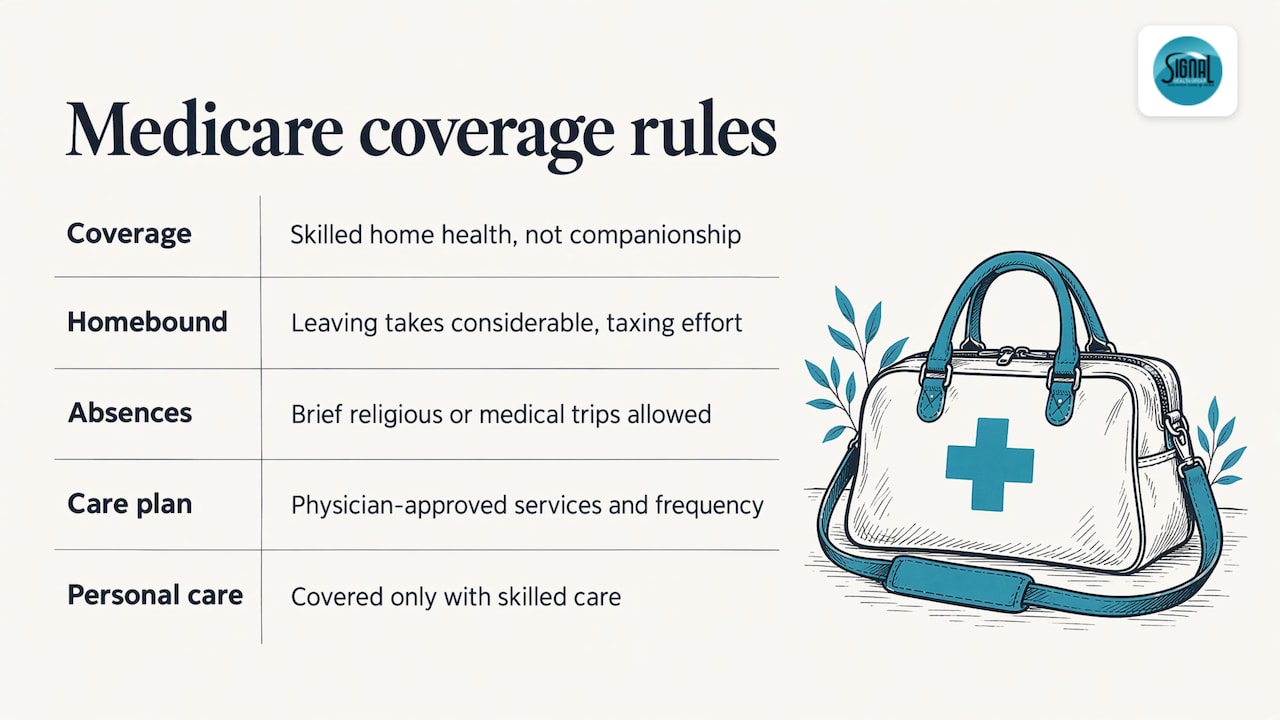
Medicare covers skilled home health, not companionship, and only under conditions. A physician must certify that the patient is confined to the home. That does not mean bedridden: leaving home must take a considerable and taxing effort, and short or infrequent absences such as religious services or medical treatment do not disqualify someone. Care follows a plan established and approved by a physician that lists the services, who provides them and how often.
The UHF guide adds that Medicare covers personal care only when the person is also receiving skilled care, and that the doctor must confirm in writing the need for skilled nursing, homebound status and a need for short-term or part-time services. In practice, a relative recovering from surgery may qualify for skilled care at home while the family arranges companionship privately. Because Signal Health Group provides both, the visits can be planned together.
How to choose a companion care provider
Whether you are hiring for a parent in your town or one across the country, these points matter most.
Hire through an agency, not alone
LTCFEDS recommends finding aides through a private-duty agency, which vets and employs the aides and handles their taxes and Social Security withholdings. Hiring an individual makes you the employer, with payroll duties and no backup if the person is sick. An agency sends a replacement and keeps a care plan on file.
Look for a provider that covers every level
A companion-only service has to hand your relative off when needs grow. A provider with personal care, skilled home health, wellness and hospice under one roof keeps the same coordinators and the same communication. Signal Health Group has a nationwide presence, so families can find care close to home.
Ask the practical questions
- What are the hourly rate and minimum weekly hours?
- Can the schedule change when your relative's needs do?
- Will the same companion visit regularly?
- How does the agency communicate with the family after each visit?
- What happens if the companion cannot come?
The NIA also advises families to get information about a service before signing an agreement, including checking references and any complaints filed with state and local regulators.
Involve your relative
Companion care works when your relative likes the person. Share their interests, routines and what they want from the visits. We emphasize open communication and give families choices about their care, so the plan reflects your relative's preferences, not just a task list.
Starting companion care: a simple plan
- List the needs. Separate social needs, household tasks and any hands-on help.
- Set a schedule. Many families start with two or three visits a week and adjust.
- Settle payment. Work out private pay, long-term care insurance or veterans benefits before the first visit.
- Introduce the companion. A short first visit with a family member present helps.
- Review after a month. Ask whether the hours and tasks still match. Add personal care or skilled care if the answers have changed.
Companion care with Signal Health Group
If your relative needs company and a hand with daily life, we can help you build a plan that fits. Signal Health Group provides in-home personal care and companionship, skilled home health from nurses and therapists, wellness programs, private-duty sitters for hospital stays, and hospice medical and emotional support. Care coordinators support scheduling and communication, and the goal is to help your relative stay independent and dignified at home.

Start with our personal care and companionship service, or look at the full range on our services page. If your family is facing a serious illness, our hospice care offers medical and emotional support at home.
When needs go beyond home companionship
Sometimes a family reaches the point where it can no longer manage. The Caregiver Toolbox advises considering nursing facility care when the person cannot manage personal needs or when family cannot cope with lifting, incontinence or supervision and services are inadequate. Before reaching that point, add services. The NIA notes that home health providers may come for a few hours each day or stay around the clock, and that after a hospital stay the hospital can help arrange a home health aide for short-term nursing care.
If your relative is in the hospital, a private-duty sitter can stay with them there, and companionship at home can resume when they return. Over time, the care plan can move from companionship to personal care, skilled care or hospice, with the same team keeping your family informed.
FAQ
What is the difference between companion care and personal care?
Companion care is social and household support: company, meals, errands, light housekeeping. Personal care is hands-on help with bathing, dressing, grooming, toileting, eating and moving around. If your relative needs any of the second list, they need a trained aide, and many people receive both from the same provider.
Does Medicare pay for companion care?
Generally no. Medicare covers short-term skilled home health for people who are homebound and under a physician's plan of care. Companionship is typically paid privately, though veterans benefits and some long-term care insurance policies may help. Medicaid rules differ by state.
How much does companion care cost per hour?
LTCFEDS reports an average of $25 to $30 per hour for private-duty care, often with a three-to-four-hour weekly minimum. Rates differ by region, so ask for a local quote.
Can a companion help my parent with bathing or medication?
No. Companions do not provide hands-on personal care or medical tasks. Bathing and dressing belong to a trained aide, and medication management and wound care to skilled nurses. We can arrange the right level for your parent.
How do I know when my parent needs more than a companion?
Watch for trouble bathing, dressing, toileting or getting out of a chair, for falls, and for safety risks tied to memory loss. If family caregivers can no longer keep up with lifting or supervision, it is time to add personal care or skilled care.
Sources
- Services for Older Adults Living at Home, National Institute on Aging
- In-Home Care, Alzheimer's Association
- When Should You Hire In-Home Help or Health Aides?, LTCFEDS
- Home Care guide, UHF Next Step in Care
- Home health guidance R302, Centers for Medicare & Medicaid Services
- The Caregiver Toolbox, Colorado Area Agency on Aging